





Hancocks
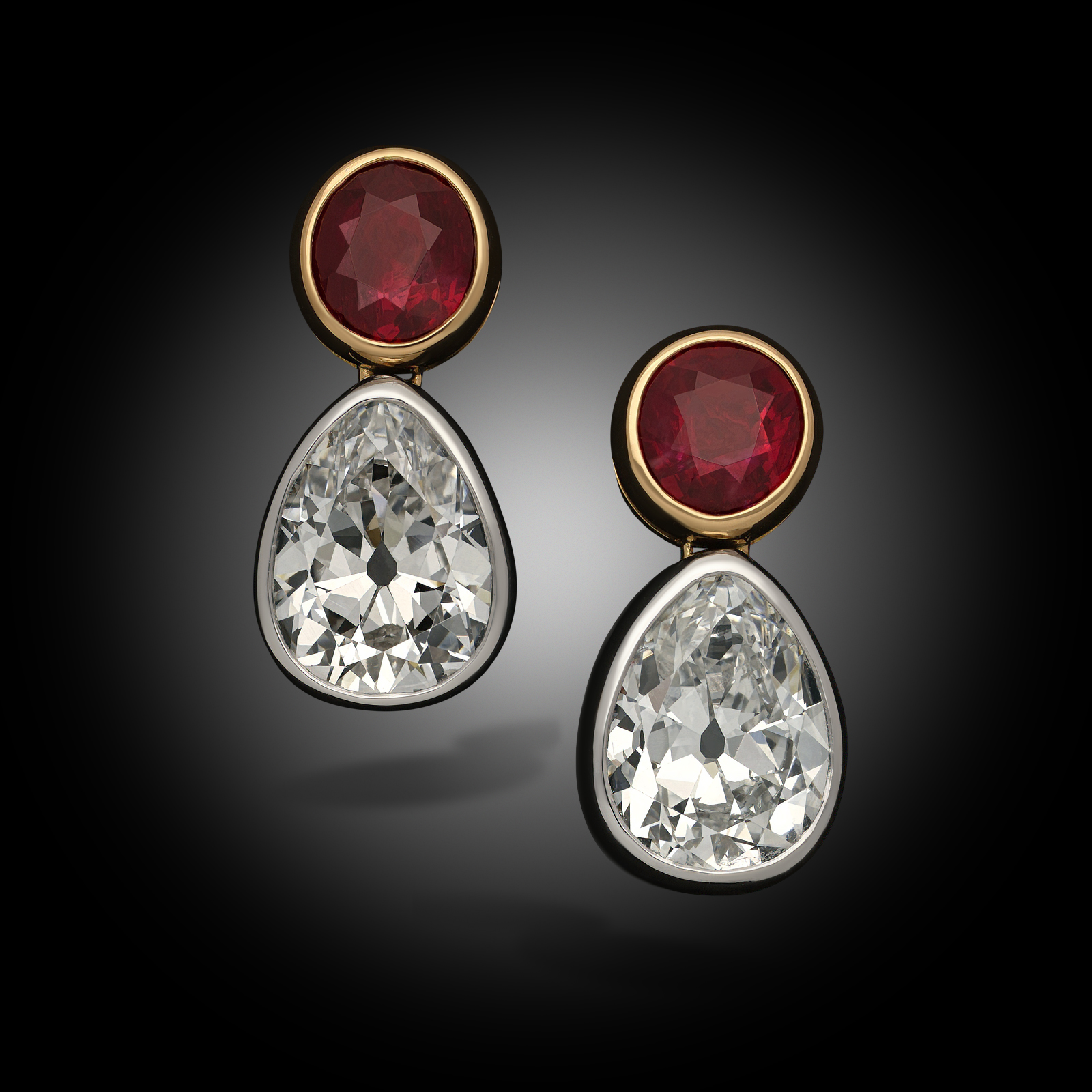
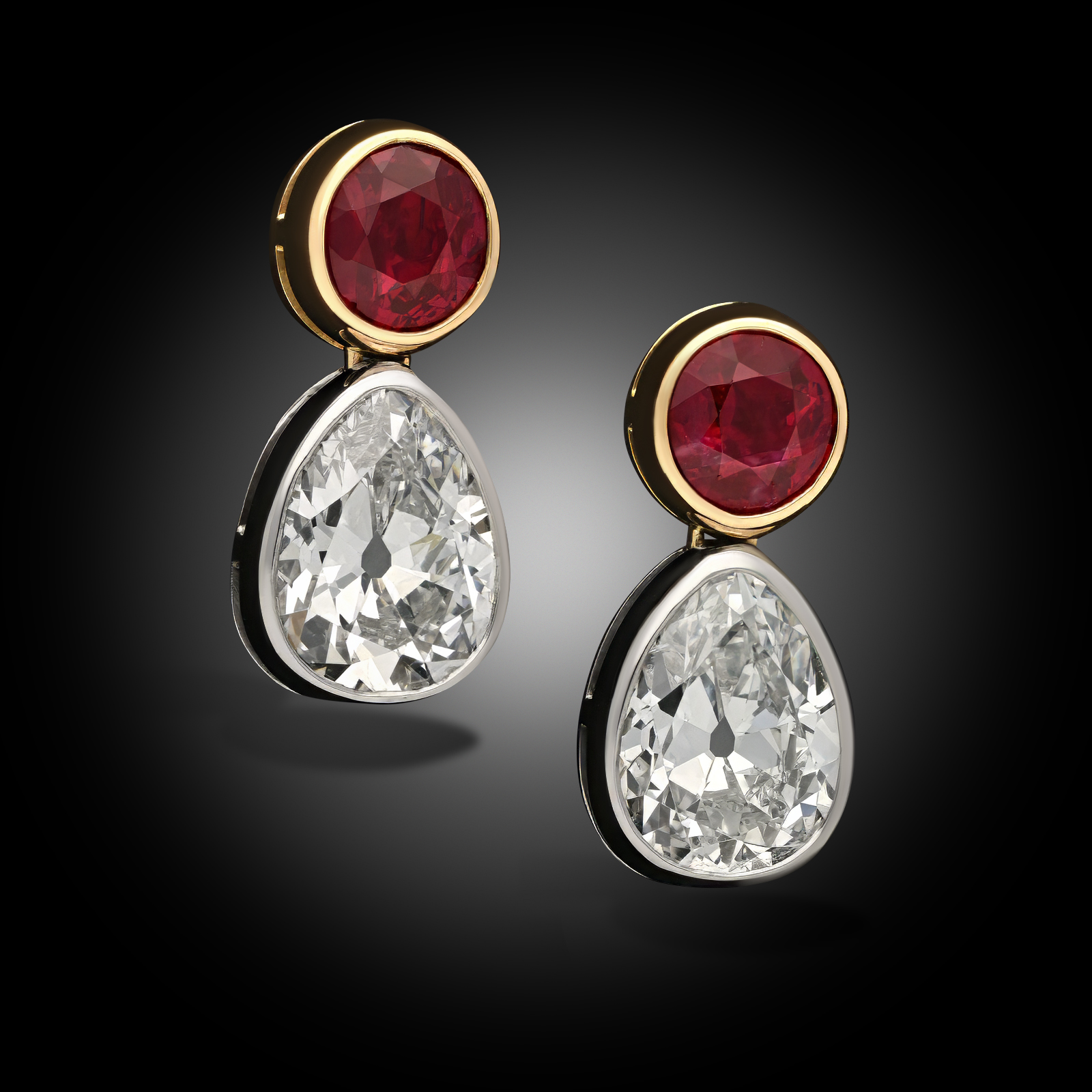
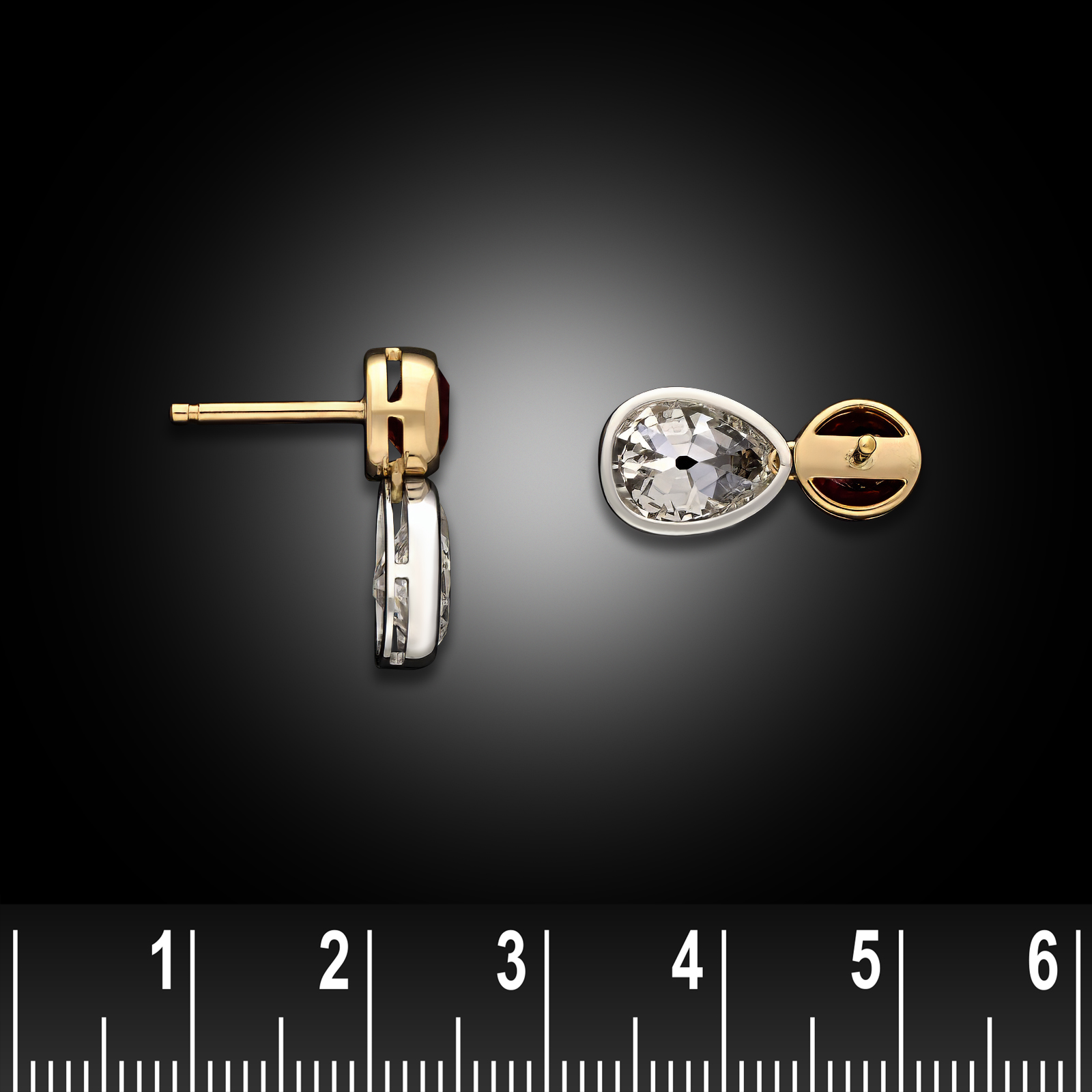
3.84ct Pear Cut Diamond and Burmese Ruby Drop Earrings
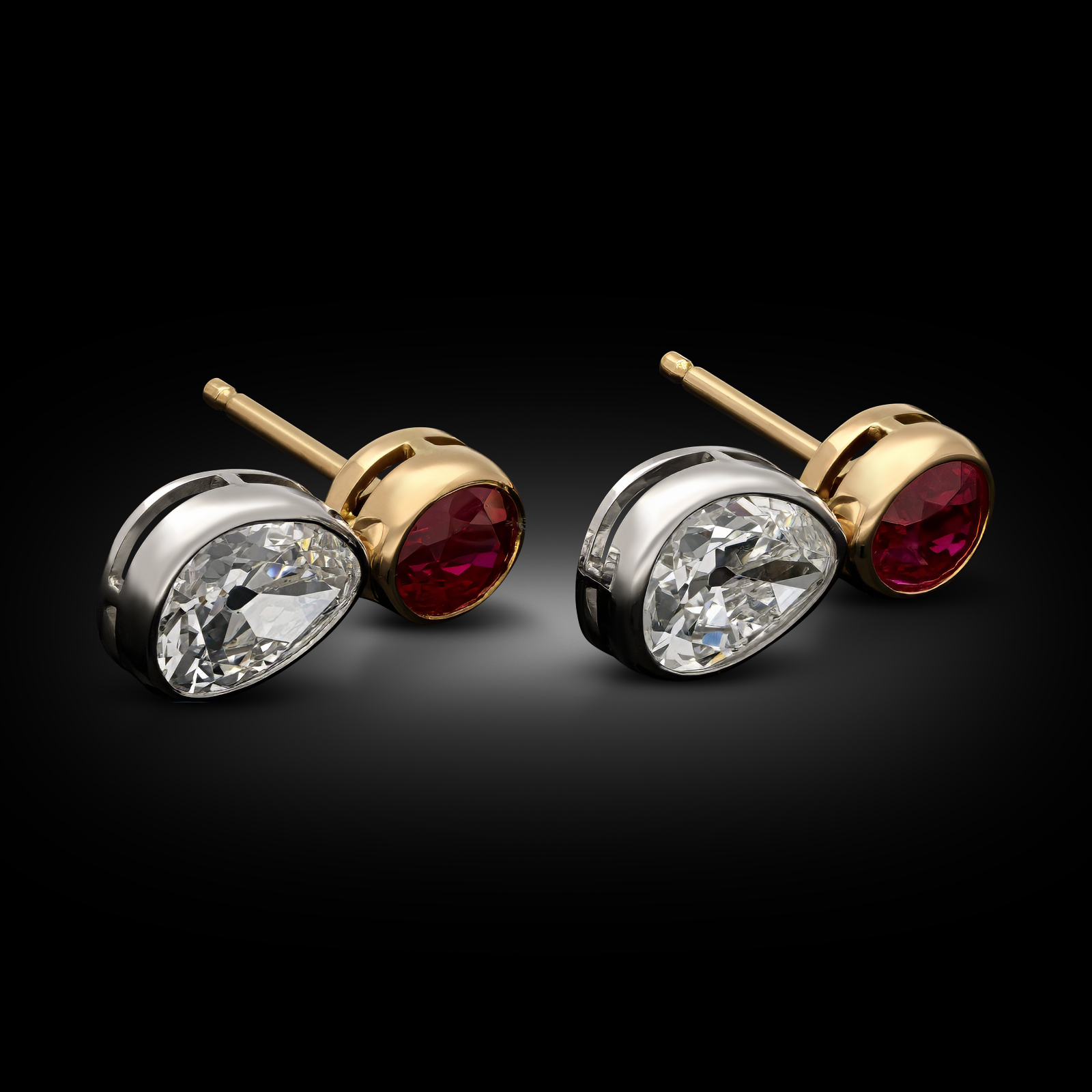
A pair of old cut diamond drop earrings by Hancocks. Each handcrafted earring is designed with antique pear cut diamonds weighing 1.92ct each and bezel set in platinum, suspended with lateral articulation from an oval cut Burmese rubies, bezel set in 18ct rose gold, to 18ct rose gold post and butterfly fittings.
£69,500.00

Information
Maker
Hancocks
Origin
London
Period
Contemporary
Gemstone
1.92ct E VS2 old cut pear shape diamond - with GIA certificate
1.92ct E SI1 old cut pear shape diamond - with GIA certificate
1.06ct oval cut unheated Burmese Ruby - with SSEF certificate
0.90ct oval cut unheated Burmese Ruby - with SSEF certificate
Setting
18ct rose gold and platinum
Dimensions
Length: 18mm
Width (at widest point): 8.4mm
Weight Description
7.2 grams
REF
128331
Discover this Jewel


The origins of this diamond cut can be traced back to 15th century Belgium and a man named Lodewyk van Bercken who was renowned throughout Europe for inventing a piece of diamond cutting machinery called a scaif. This rotating wheel impregnated with oil and diamond powder facilitated a quality of diamond cutting and polishing previously unknown. As van Bercken’s reputation as a diamond cutter spread, he was able to experiment more freely and this resulted in the development of the pear shape amongst others. Early pear shapes, like their rounded sisters, were gentler in form than today’s modern cuts. Proportions can vary hugely with this shape from wide soft pears to long narrow ones but the antique cuts we favour are of the softer variety. Typically on the fuller side with a softly curved end and a gently rounded tip they often have a flat open culet and faceting style that resembles old mine cut diamonds. The smaller table facet and higher crown allow these old cuts to display a wonderful fire and liveliness which, coupled with their beautiful shape, makes them particularly alluring. The most famous pear shape diamond is the historic Cullinan I, which is also the world’s largest colourless cut diamond weighing in at 530.2cts. It is set in the top of the Sovereign’s Sceptre which is part of the British Crown Jewels and is used during coronation services.

0.5CT
0.5 carat

1.0CT
1 carat

1.5CT
1.5 carat

2.0CT
2 carat

3.0CT
3 carat

4.0CT
4 carat

5.0CT
5 carat

6.0CT
6 carat
(Diagrams not to precise scale)
Today, this C is often the first thing someone asks about but it is worth remembering that not all diamonds that weigh the same will look the same size to the eye because it will depend on the cut of the stone and particularly its depth. With regards to the impact of weight on price then the price per carat will obviously rise as the carat weight increase. However, it must be noted that as larger diamonds are rarer than smaller ones the price does not rise evenly, for example a 2ct diamond is not simply double the price of a 1ct diamond.

D
Exceptional White +

E
Exceptional White

F
Rare White +
Colourless

G
Rare White

H
White

I
Slightly Tinted

J
Slightly Tinted White
Near Colourless
(Diagrams not to precise scale)
In terms of how this affects price, essentially, the whiter the diamond and higher the colour grade the greater the value of the diamond. However, it is important to remember that a lower colour grade does not equate to a lower quality, the grade is a measure of rarity, the whiter stones are simply rarer and therefore command higher prices.
The chart below shows the colour grading scale used by the GIA, the Gemmological Institute of America.

FL
Flawless
No inclusions or blemishes of any sort are visable to a skilled diamond grader using 10x magnification.

IF
Internally Flawless
No inclusions and only blemishes are visable to a skilled diamond grader using 10x magnification.

VVS
Very Very Slightly Included
Inclusions are difficult for a skilled diamond grader to see using 10x magnification.

VS
Very Slightly Included
Inclusions are noticeable to a skilled diamond grader to see using 10x magnification.

SI
Slightly Included
Slight inclusions are noticeable to a skilled grader using 10x magnification.
(Diagrams not to precise scale)
All these factors are taken into account and a judgement is made as to how detrimental they are to the overall appearance of the diamond. It is worth remembering that, unlike colour grading, clarity grading is done under 10x magnification with a microscope so any inclusion in a diamond will be far less noticeable to the naked eye than it is to the diamond grader. Ultimately the cleaner the diamond, the fewer the inclusions and less impact they have – the better the clarity grade will be. The table below shows the grading system used by the GIA.


(Diagrams not to precise scale)
1. Brilliance: This refers to the reflection of white light from both the surface and the inside of a diamond.
2. Fire: This is the term we give to the coloured flashes you see in a diamond resulting from the splitting up of white light into its spectral colours.
3. Scintillation: This is the sparkle a diamond displays, the pattern of light and dark flashes caused by reflections of light as a diamond is moved. Other considerations include symmetry and the quality of the polish which impacts how well the light reflects off the surface of the diamond.

Rubies
Burma Ruby

Rubies mined in Burma have long been held as the absolute ideal in terms of colour for a ruby, they are an exceptionally beautiful rich deep red with neither too much brown nor pink in it.
The term ‘pigeon’s blood’ has historically been used in an attempt to define this colour that is found in the best examples produced by this region. The Mogok Valley in Upper Burma (now known as Myanmar) has been the world’s primary ruby source for centuries and the origins of the mines are swathed in mystery and legend. What is certain is that references to these gems have been found dating back to the Shan Dynasty in the 6th Century. The mines were taken over by the King of Burma in 1597 and all rubies over a certain size had to be given to him on discovery rather than sold. Today there are many different mines in the area both privately owned and government run. New deposits were found in the Mong Hsu area of the country in the 1990’s and more recently a new source has been discovered in the northern region of Namya.
The design of the French cut had developed from the addition of extra facets to old table cut diamonds thereby altering them into much more lively stones. This style of cut has changed very little to this day and its evolution marks one of the earliest milestones in the development of the brilliant cut diamonds we know today.
Pigeon’s Blood Rubies

Historically, the term ‘pigeon’s blood’ has been used to describe the most beautiful and coveted colour for rubies, allegedly due to its similarity in colour to the blood of a pigeon.
Opinions differ as to the exact origin of the term with some saying it came from the Burmese, others that it was first used by the Chinese who had previously owned the area where the Burmese ruby mines were discovered and yet others sighting it as having Hindustani origins where lapidaries compared the colour to the blood red of a pigeon’s eye. Whatever the truth, one thing everyone agreed on is that only rubies of the finest vivid red colour with deep saturation and which showed a soft red fluorescence in daylight were referred to this way. Today rubies from both Burma and Mozambique can show this coveted colour and be certified as such.
Mozambique Rubies

The first significant ruby deposit in Mozambique was discovered in 2009 in an area called Montepuez. Remarkably, in less than fifteen years this country has become the world’s most productive source of gem-quality rubies.
Importantly, the output is not only significant in quantity but also in quality. The rubiesoccur in a wide range of qualities and characteristics but the best of them are low in iron and high inchromium like those from Burma and exhibit a similar vibrant colour with a strong fluorescence. The bestof the best of these will be given with the coveted ‘pigeon’s blood’ colour grade. A percentage of thesecombine this highly desirable colour with a level of clarity that means the stones require no treatment toimprove them. This means that excellent quality, untreated stones are available and these are the oneswe select for our jewellery.
Director’s Notes
The pear shaped diamond has long been loved for its elegant and flattering tear drop shape. It is unusual for a diamond cut in that it is one of very few shapes that is not symmetrical but instead combines both the generous curved form of a round brilliant with the elongated tapering point of a marquise shape. The origins of this diamond cut can be traced back to 15th century Belgium and a man named Lodewyk van Bercken who was renowned throughout Europe for inventing a piece of diamond cutting machinery called a scaif. This rotating wheel impregnated with oil and diamond powder facilitated a quality of diamond cutting and polishing previously unknown. As van Bercken’s reputation as a diamond cutter spread, he was able to experiment more freely and this resulted in the development of the pear shape amongst others. Early pear shapes, like their rounded sisters, were gentler in form than today’s modern cuts. Proportions can vary hugely with this shape from wide soft pears to long narrow ones but the antique cuts we favour are of the softer variety. Typically on the fuller side with a softly curved end and a gently rounded tip they often have a flat open culet and faceting style that resembles old mine cut diamonds. The smaller table facet and higher crown allow these old cuts to display a wonderful fire and liveliness which, coupled with their beautiful shape, makes them particularly alluring. The most famous pear shape diamond is the historic Cullinan I, which is also the world’s largest colourless cut diamond weighing in at 530.2ct. It is set in the top of the Sovereign’s Sceptre which is part of the British Crown Jewels.

