



Hancocks
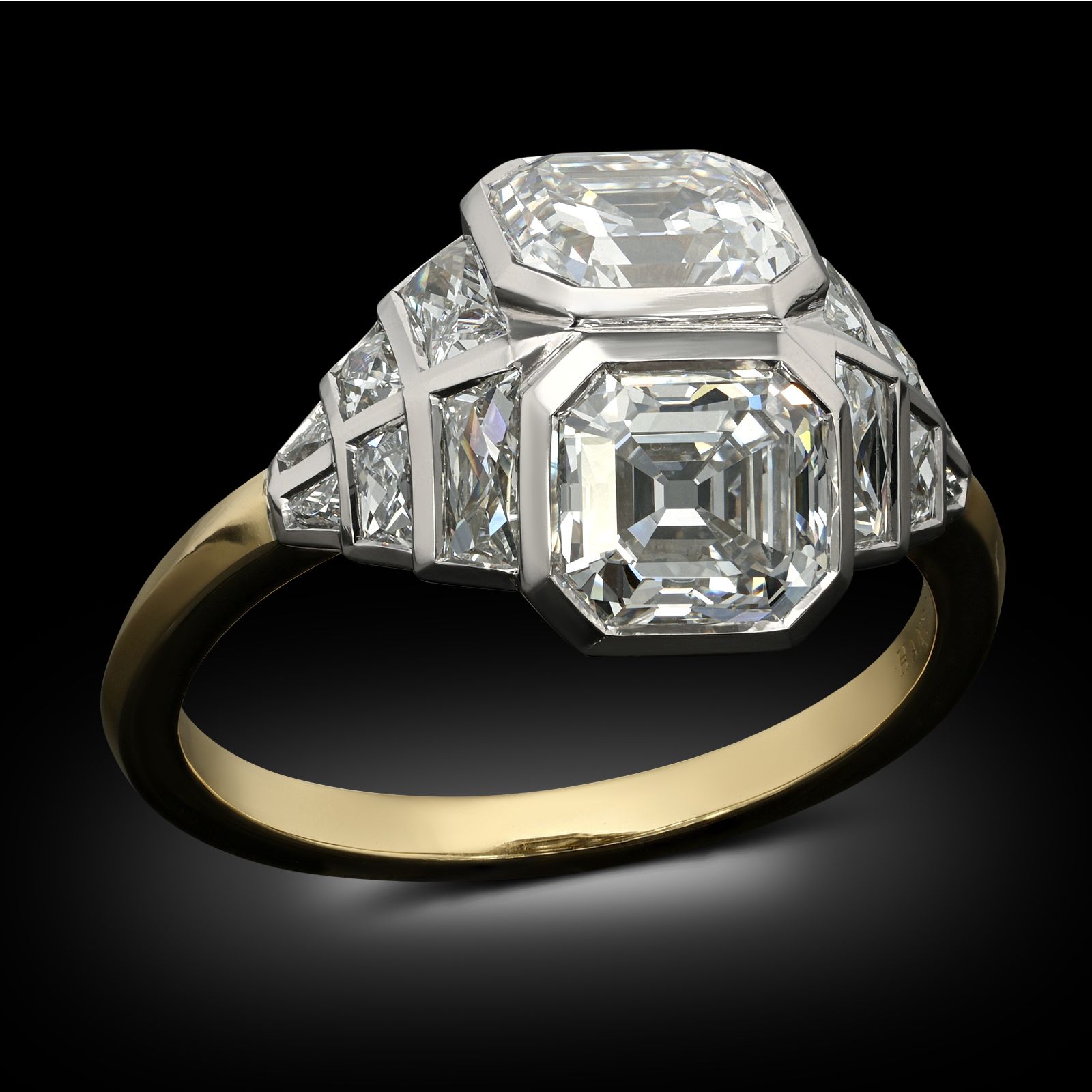
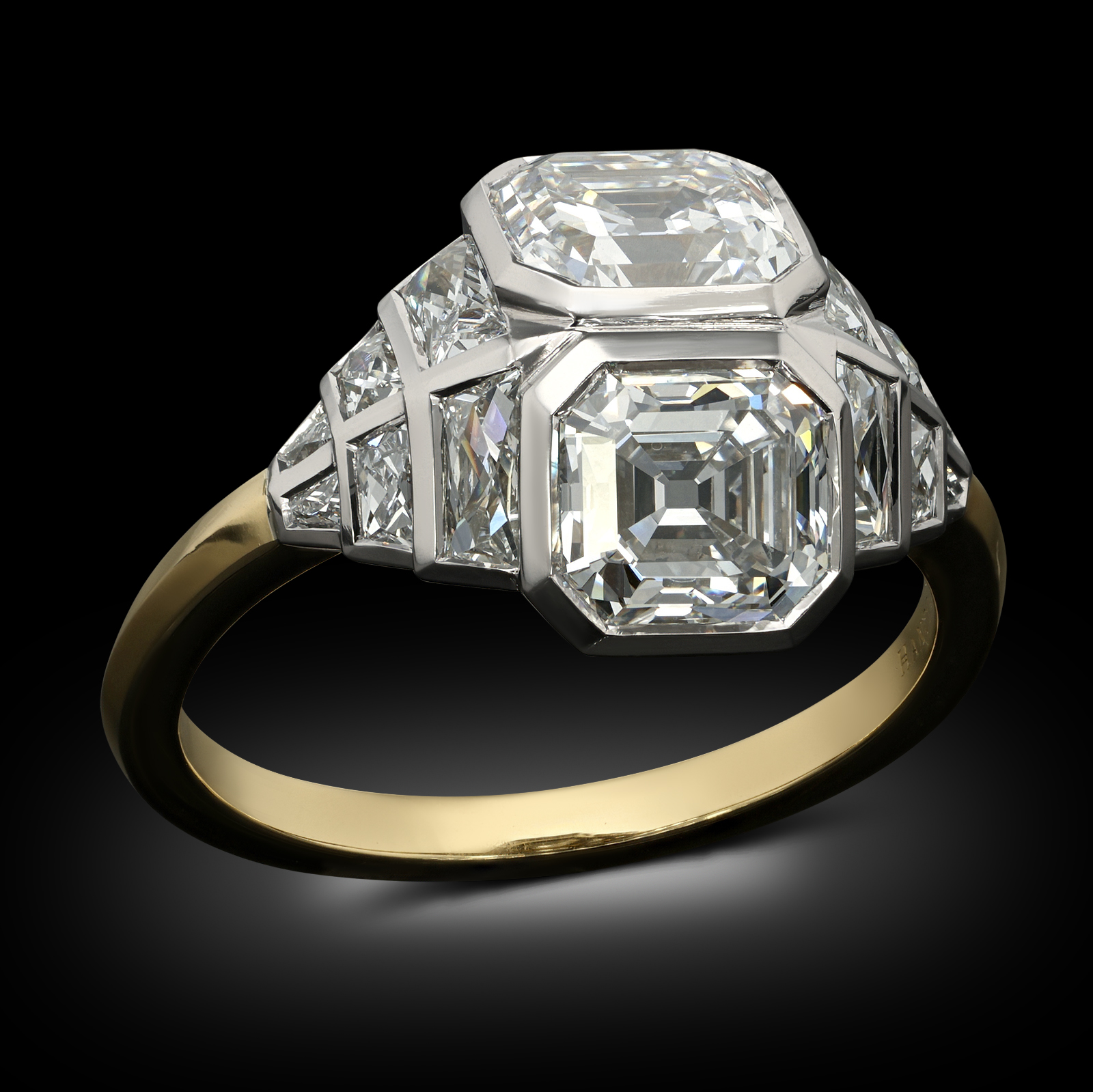
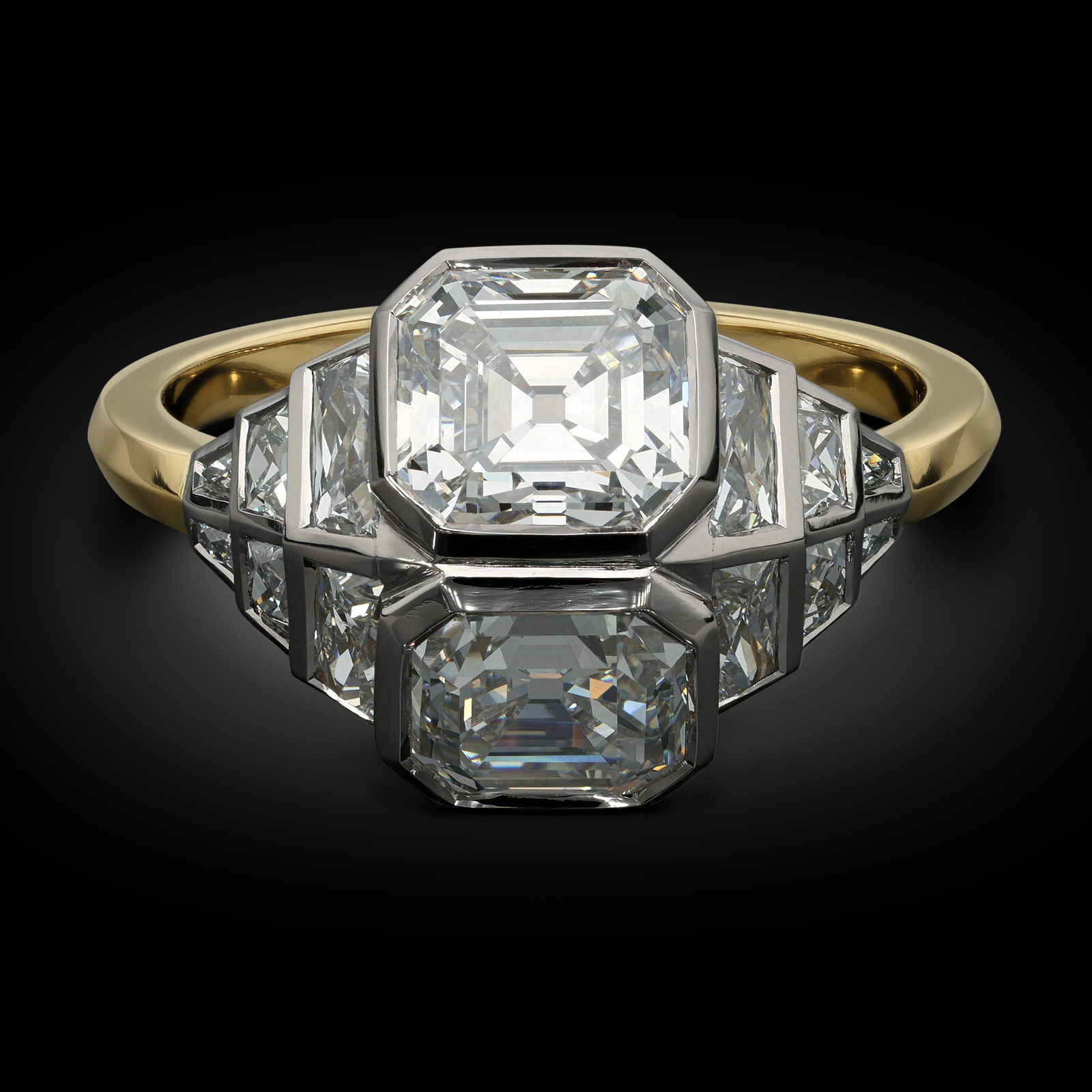
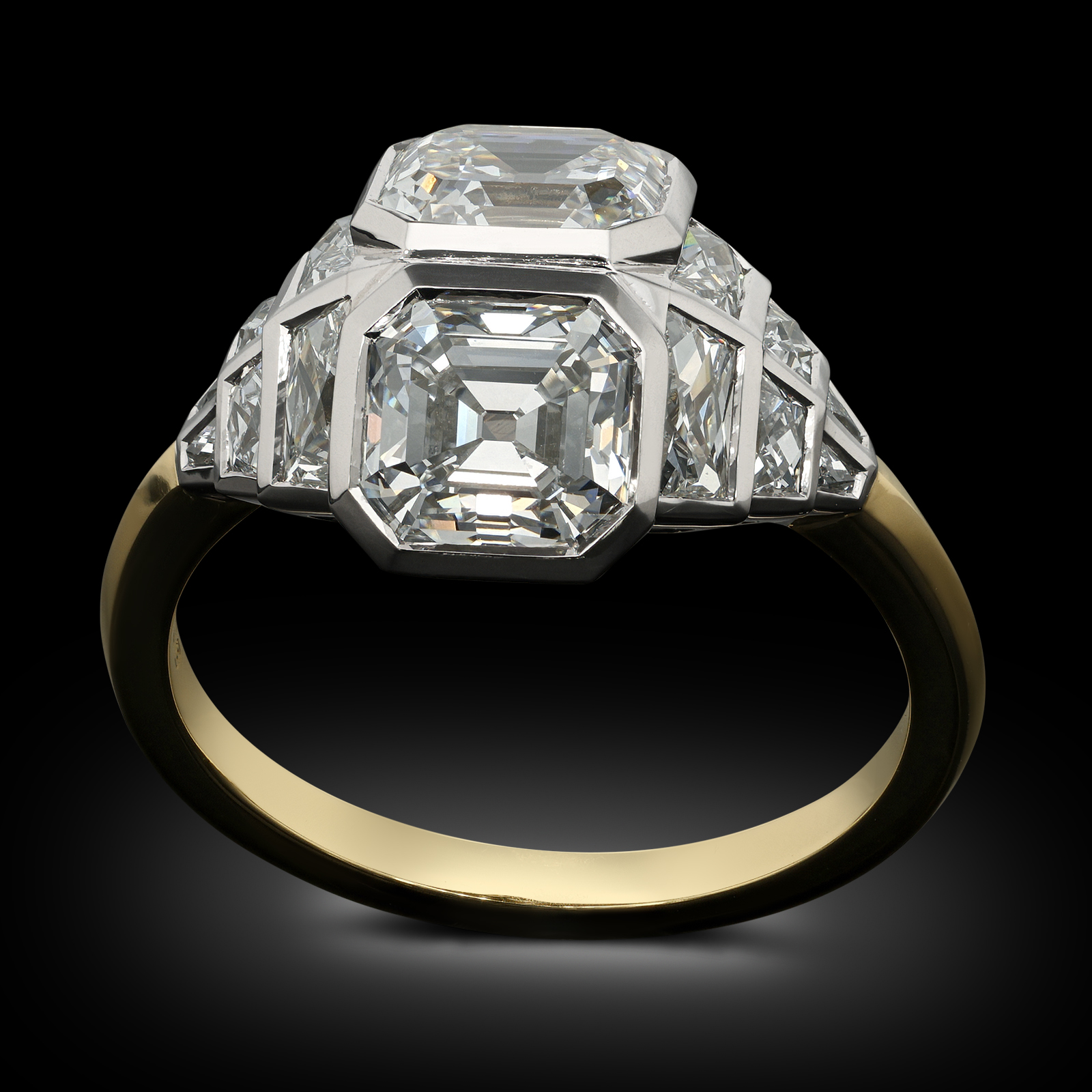
2.47ct Asscher Cut Double Diamond Ring
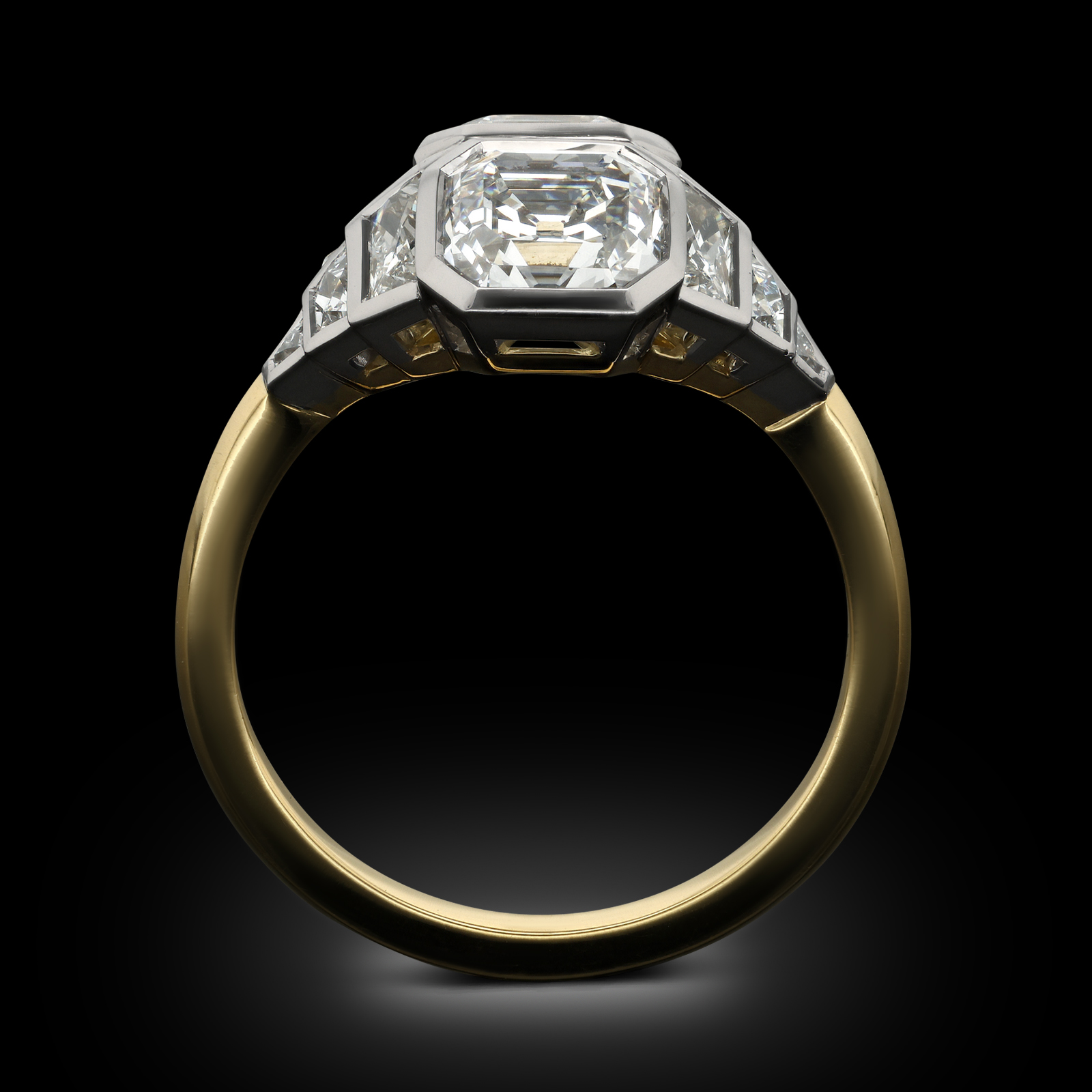
A handcrafted old cut double diamond ring by Hancocks. The geometric ring is designed as a vertically set pair of vintage Asscher cut diamonds, flanked on either side by calibrated French cut diamonds, all bezel set in platinum to a polished 18ct yellow gold knife-edge band.
£38,500.00

Information
Maker
Hancocks
Origin
London
Period
Contemporary
Gemstone
1.26ct E VVS2 Asscher cut diamond - with GIA certificate
1.21ct E VVS2 Asscher cut diamond - with GIA certificate
12 x French cut diamonds, total weight 0.54ct
Setting
18ct yellow gold and platinum
Dimensions
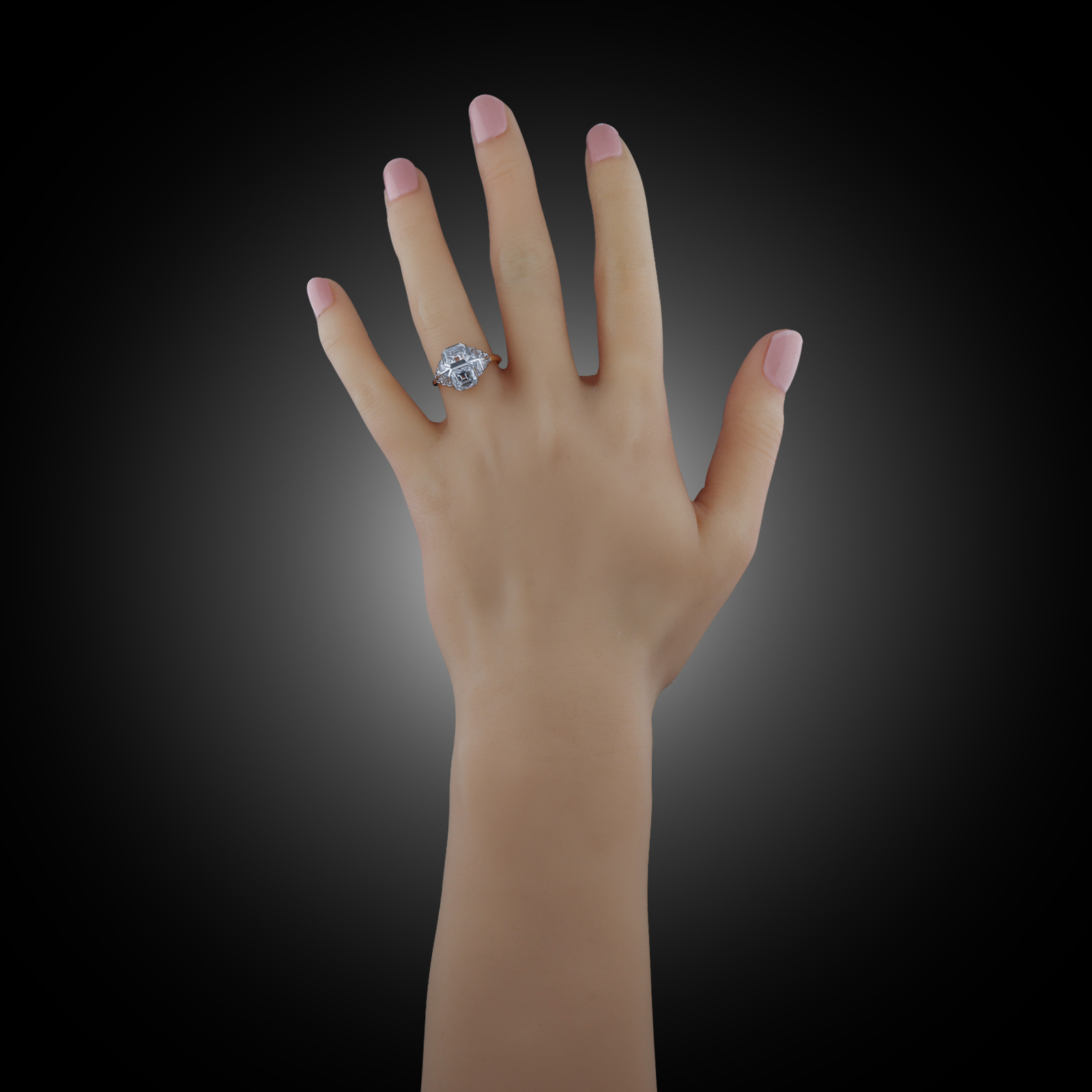
cUK finger size M, US size 6.25 (can be adjusted to fit any size)
Head: 1.2cm x 1.6cm
Band width: 2mm
Weight Description
5.3 grams
REF
122532
Discover this Jewel
Asscher Cut
The Asscher cut diamond was designed by and named after Joseph Asscher, co-founder of the Asscher Diamond Company in Amsterdam whose family had been dealing in diamonds since the mid 19th Century.


The cut was created in 1902, in an attempt to best utilise the natural shape of rough octahedral diamond crystals. The cut is often square in shape with deeply truncated corners creating an almost octagonal outline to the stone.
The facets are carefully arranged in three rows of straight, step-like faces to the top and bottom of the stone which has a wonderfully elegant and clean appearance with a more subtle sparkle than brilliant style cuts. A characteristic high crown and deep pavilion are further hallmarks of this cut and these help to create a wonderful brilliance in the stone. This was the first diamond cut to ever be officially patented and it became increasingly popular during the early 20th century. In particular, the straight lines and geometric form of the cut lent itself beautifully to the aesthetic of the Art Deco period. Just a few years after creating his eponymous diamond cut, Joseph Asscher would become internationally famous as the man who cut the Cullinan diamond, at that time, the largest diamond in the world. Popular rumour has it that after the first attempt to cleave the diamond in half, Asscher fainted but in fact his family state he simply collapsed with the effort it took to strike a blow hard enough to cleave a diamond that size.
Antique asschers particularly stand out from their modern counterparts with much bigger cut corners that enhance the play of light within the steeper facet pattern.
The facets are carefully arranged in three rows of straight, step-like faces to the top and bottom of the stone which has a wonderfully elegant and clean appearance with a more subtle sparkle than brilliant style cuts. A characteristic high crown and deep pavilion are further hallmarks of this cut and these help to create a wonderful brilliance in the stone. This was the first diamond cut to ever be officially patented and it became increasingly popular during the early 20th century. In particular, the straight lines and geometric form of the cut lent itself beautifully to the aesthetic of the Art Deco period. Just a few years after creating his eponymous diamond cut, Joseph Asscher would become internationally famous as the man who cut the Cullinan diamond, at that time, the largest diamond in the world. Popular rumour has it that after the first attempt to cleave the diamond in half, Asscher fainted but in fact his family state he simply collapsed with the effort it took to strike a blow hard enough to cleave a diamond that size.
Antique asschers particularly stand out from their modern counterparts with much bigger cut corners that enhance the play of light within the steeper facet pattern.
The facets are carefully arranged in three rows of straight, step-like faces to the top and bottom of the stone which has a wonderfully elegant and clean appearance with a more subtle sparkle than brilliant style cuts. A characteristic high crown and deep pavilion are further hallmarks of this cut and these help to create a wonderful brilliance in the stone. This was the first diamond cut to ever be officially patented and it became increasingly popular during the early 20th century. In particular, the straight lines and geometric form of the cut lent itself beautifully to the aesthetic of the Art Deco period. Just a few years after creating his eponymous diamond cut, Joseph Asscher would become internationally famous as the man who cut the Cullinan diamond, at that time, the largest diamond in the world. Popular rumour has it that after the first attempt to cleave the diamond in half, Asscher fainted but in fact his family state he simply collapsed with the effort it took to strike a blow hard enough to cleave a diamond that size.
Antique asschers particularly stand out from their modern counterparts with much bigger cut corners that enhance the play of light within the steeper facet pattern.

0.5CT
0.5 carat

1.0CT
1 carat

1.5CT
1.5 carat

2.0CT
2 carat

3.0CT
3 carat

4.0CT
4 carat

5.0CT
5 carat

6.0CT
6 carat
(Diagrams not to precise scale)
Today, this C is often the first thing someone asks about but it is worth remembering that not all diamonds that weigh the same will look the same size to the eye because it will depend on the cut of the stone and particularly its depth. With regards to the impact of weight on price then the price per carat will obviously rise as the carat weight increase. However, it must be noted that as larger diamonds are rarer than smaller ones the price does not rise evenly, for example a 2ct diamond is not simply double the price of a 1ct diamond.

D
Exceptional White +

E
Exceptional White

F
Rare White +
Colourless

G
Rare White

H
White

I
Slightly Tinted

J
Slightly Tinted White
Near Colourless
(Diagrams not to precise scale)
In terms of how this affects price, essentially, the whiter the diamond and higher the colour grade the greater the value of the diamond. However, it is important to remember that a lower colour grade does not equate to a lower quality, the grade is a measure of rarity, the whiter stones are simply rarer and therefore command higher prices.
The chart below shows the colour grading scale used by the GIA, the Gemmological Institute of America.

FL
Flawless
No inclusions or blemishes of any sort are visable to a skilled diamond grader using 10x magnification.

IF
Internally Flawless
No inclusions and only blemishes are visable to a skilled diamond grader using 10x magnification.

VVS
Very Very Slightly Included
Inclusions are difficult for a skilled diamond grader to see using 10x magnification.

VS
Very Slightly Included
Inclusions are noticeable to a skilled diamond grader to see using 10x magnification.

SI
Slightly Included
Slight inclusions are noticeable to a skilled grader using 10x magnification.
(Diagrams not to precise scale)
All these factors are taken into account and a judgement is made as to how detrimental they are to the overall appearance of the diamond. It is worth remembering that, unlike colour grading, clarity grading is done under 10x magnification with a microscope so any inclusion in a diamond will be far less noticeable to the naked eye than it is to the diamond grader. Ultimately the cleaner the diamond, the fewer the inclusions and less impact they have – the better the clarity grade will be. The table below shows the grading system used by the GIA.


(Diagrams not to precise scale)
1. Brilliance: This refers to the reflection of white light from both the surface and the inside of a diamond.
2. Fire: This is the term we give to the coloured flashes you see in a diamond resulting from the splitting up of white light into its spectral colours.
3. Scintillation: This is the sparkle a diamond displays, the pattern of light and dark flashes caused by reflections of light as a diamond is moved. Other considerations include symmetry and the quality of the polish which impacts how well the light reflects off the surface of the diamond.

Director’s Notes
The Asscher cut was designed by Joseph Asscher in 1902 in an attempt to best utilise the natural shape of octahedral diamond crystals. The cut is essentially a square shape with the corners cut off quite steeply creating an almost octagonal outline to the stone. The facets are carefully arranged in three rows of straight, step-like faces to the top and bottom of the stone which has a wonderfully elegant and clean appearance with a more subtle sparkle than cuts such as the round brilliant. The Asscher family have been diamond dealers since the mid 19th Century and are probably best known as the company entrusted with the cleaving and cutting of the world famous Cullinan diamond.


