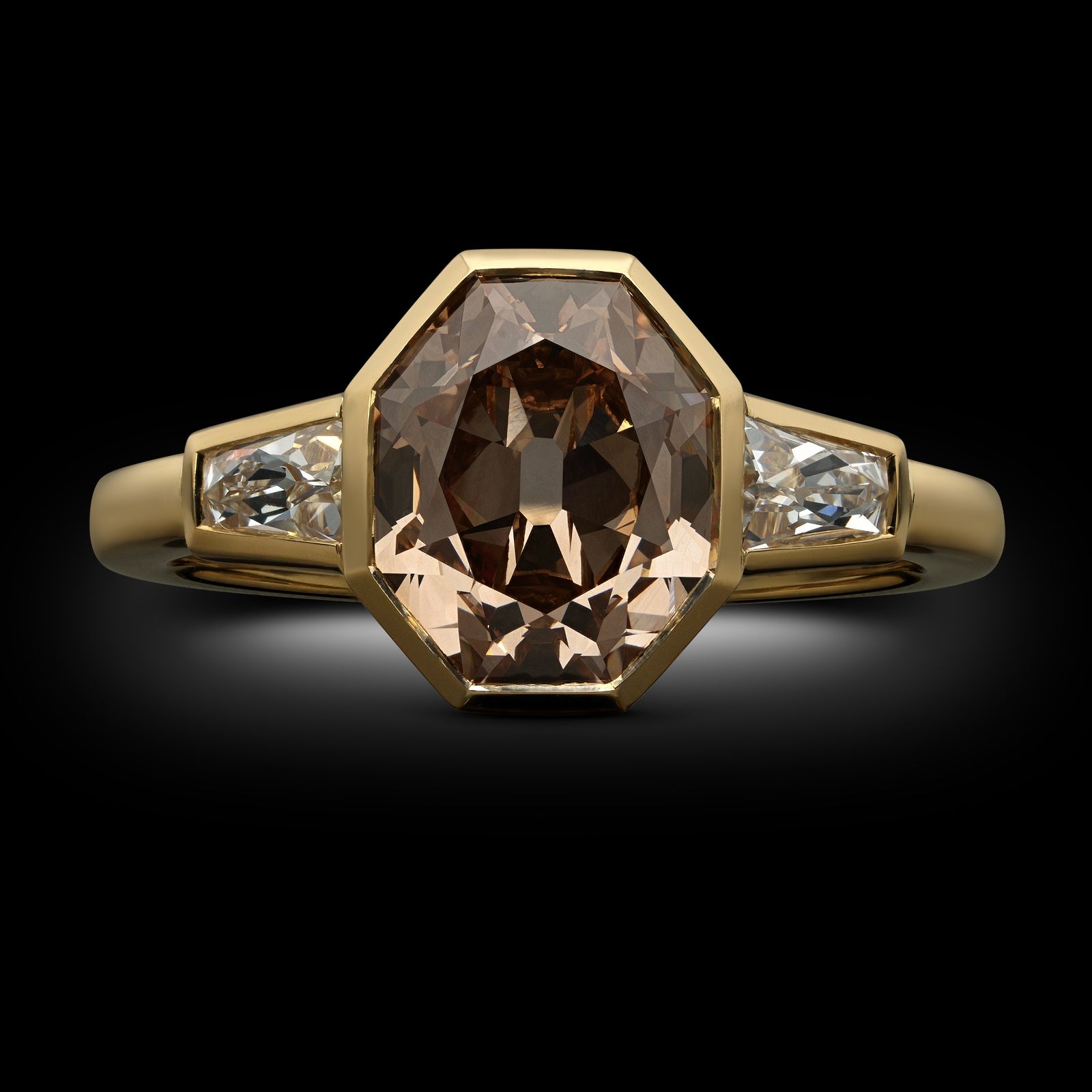
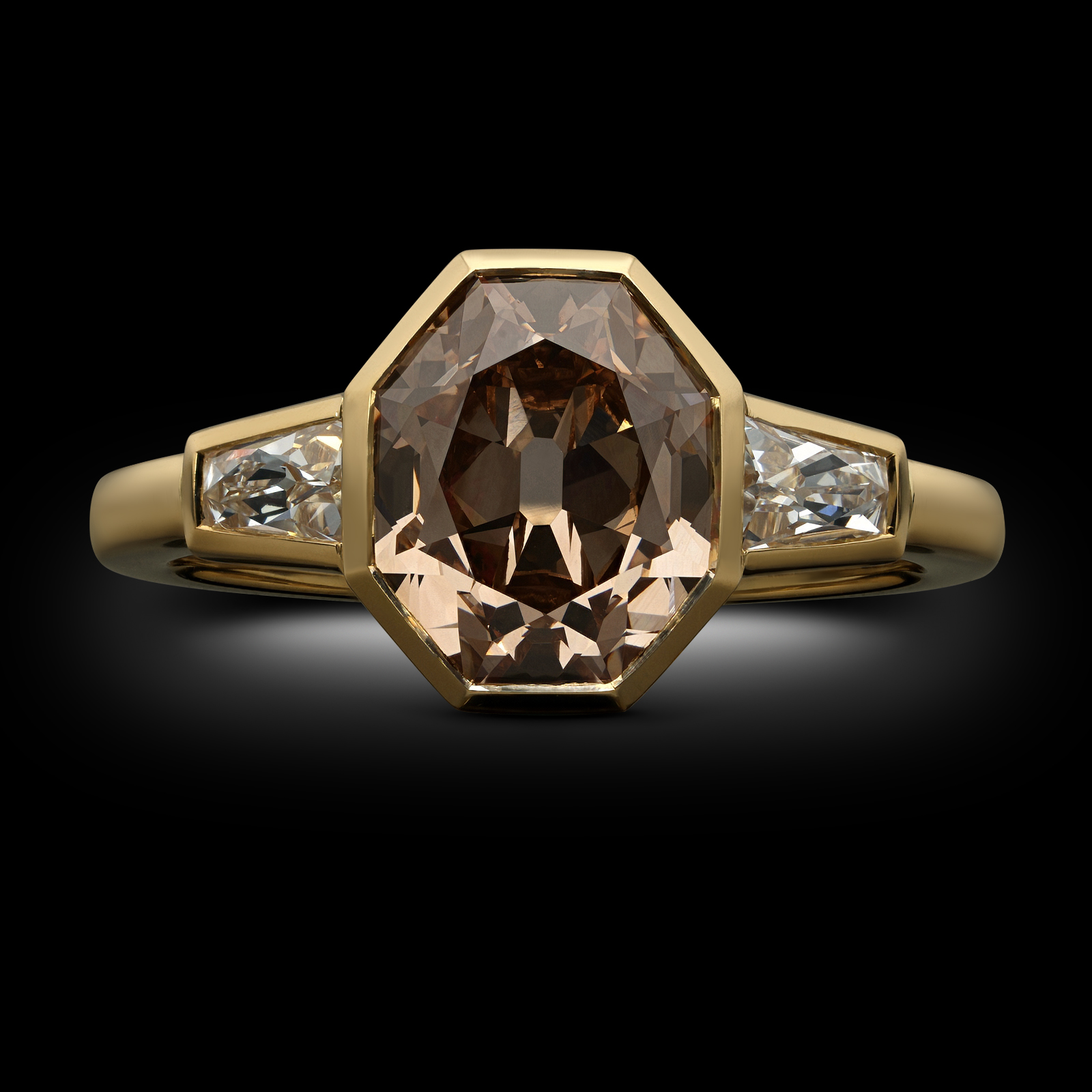
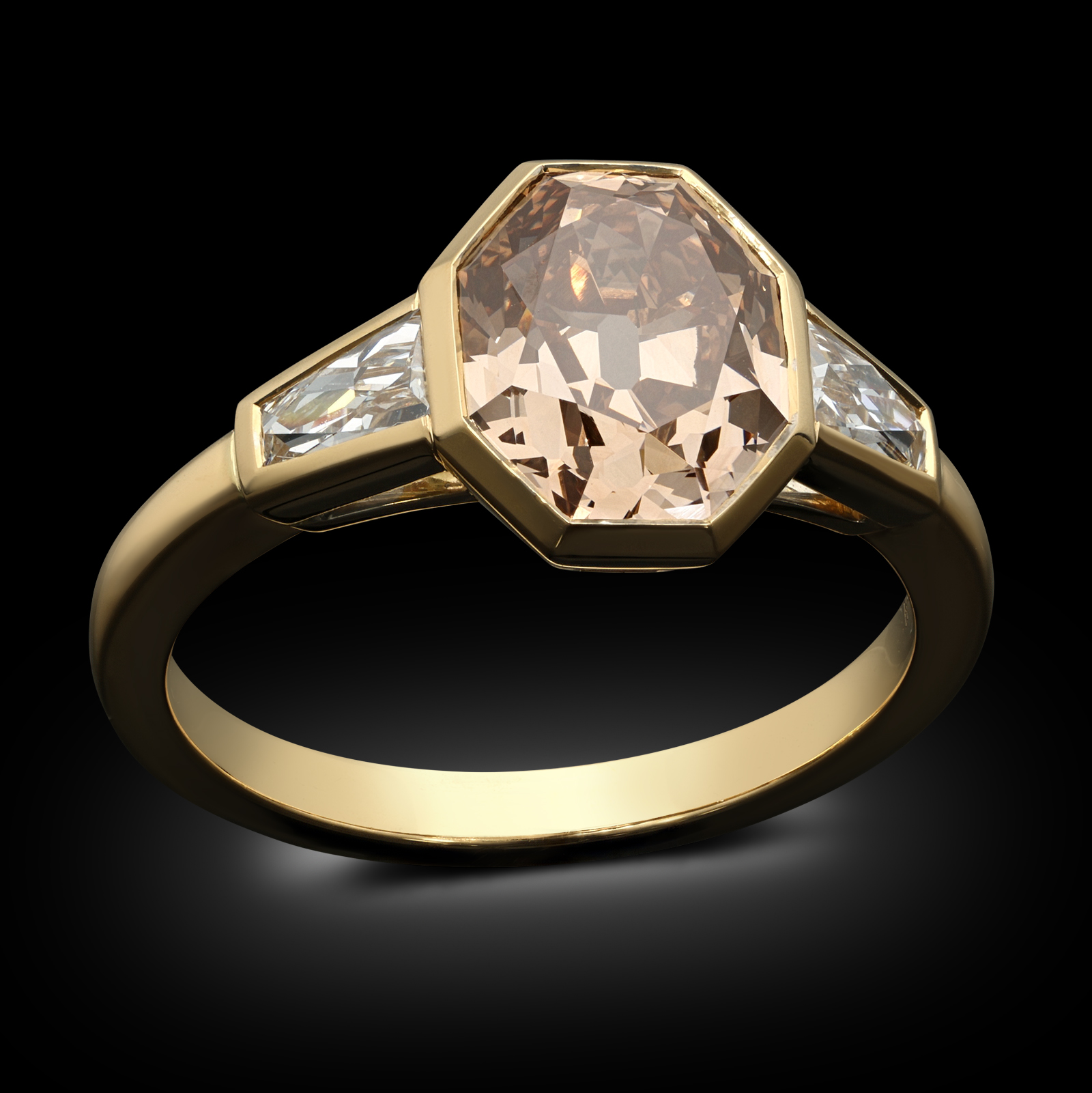
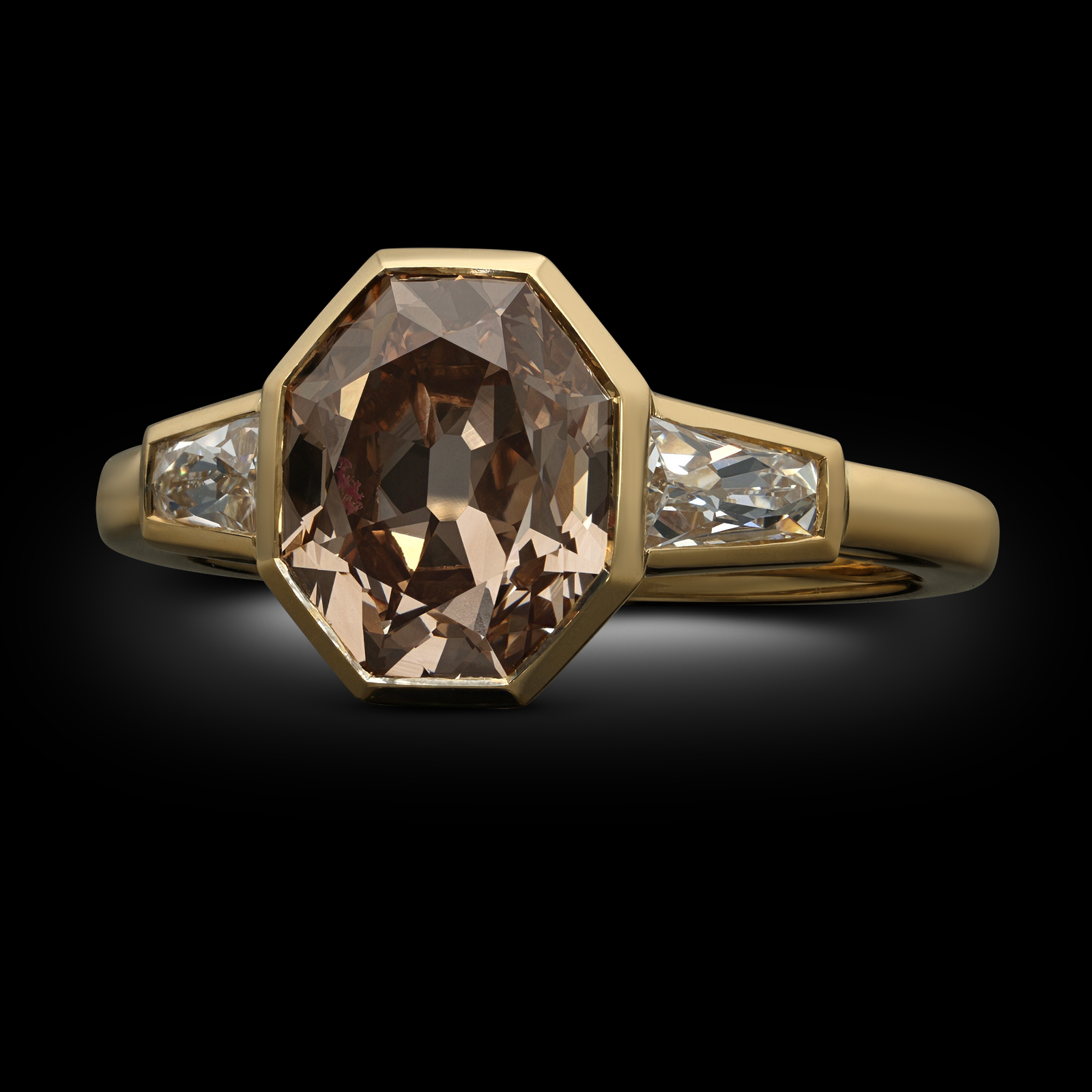
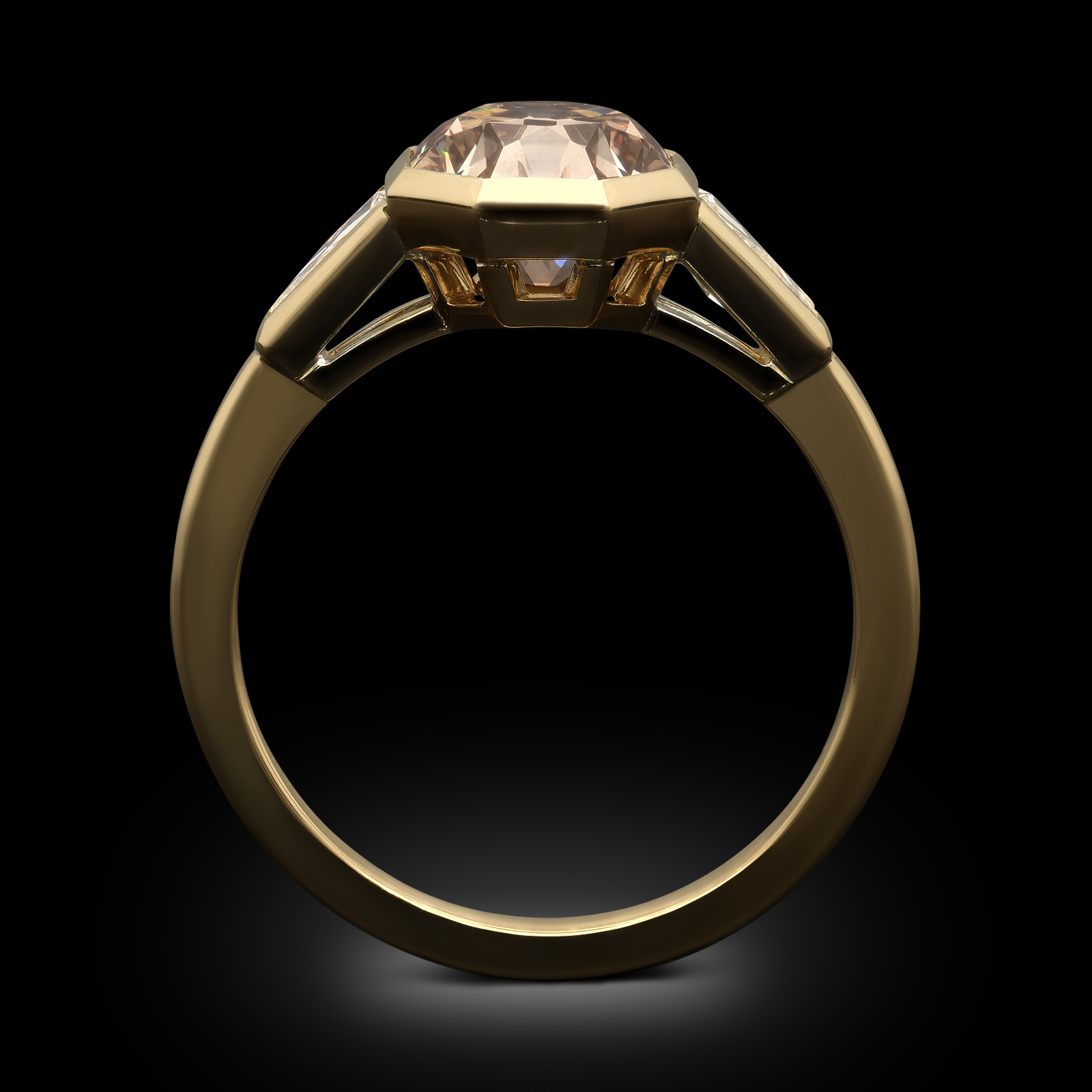
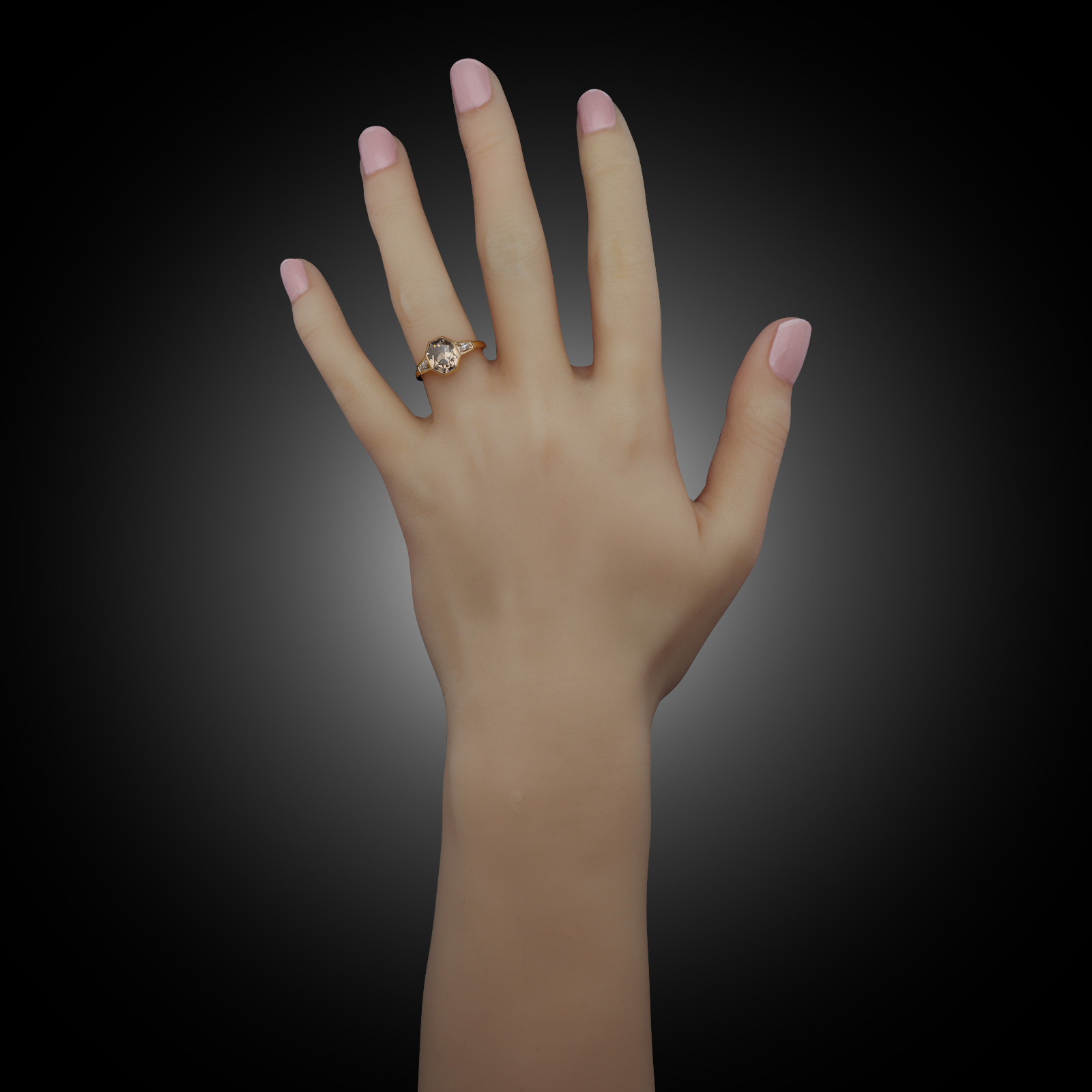
2.16ct Fancy Colour Octagonal Brilliant Cut Diamond Ring
A handcrafted old cut fancy colour and white diamond ring by Hancocks. The central 2.16ct fancy yellowish-brown octagonal brilliant cut diamond is set between shoulders of tapered French cut white diamonds, all bezel set within a polished 18ct yellow gold mount and to a square-profile band.
£19,500.00
Thank you for your enquiry
Your message has been received by Hancocks and a member of our team will be in touch within 1–2 business days.
2.16ct Fancy Yellowish Brown VS1 octagonal brilliant diamond - with GIA certificate
2 x tapered French cut diamonds, total weight 0.38ct
Setting
18ct yellow gold
Dimensions
UK finger size K 1/2, US size 5.5 (can be adjusted to fit any size)
Head: 9.5mm x 15.5mm (inclusive of shoulders)
Band width: 2mm
Weight Description
4 grams
REF
130716
Discover this Jewel
Diamonds
Golconda & Type IIa Diamonds
All diamonds can be classified into two main categories which are referred to as ‘types’,
depending on the trace elements that are naturally present within the carbon crystal structure
of the diamond.
Type I diamonds contain small amounts of nitrogen whereas Type II diamonds do not. Each of these types is then subdivided further and
the term Type IIA is used to denote the very purest diamonds. This means
there are no measurable impurities in the diamond of any kind which makes these stones
exceptionally rare, they make up less than 2% of all gem quality diamonds found worldwide. Not
only can these stones be perfectly colourless but they also possess an exceptional level of
transparency which enhances their beauty and allows the brilliance and fire of the diamond to be
appreciated to the fullest. Famous examples of Type IIA diamonds include the Koh-i-Noor and the Cullinan, which are part of the Crown Jewels, as well as the Krupp diamond which Richard Burton
bought for Elizabeth Taylor and was later renamed the Elizabeth Taylor
Diamond.
The design of the French cut had developed from the addition of extra facets to old table cut
diamonds thereby altering them into much more lively stones.This style of cut has changed very
little to this day and its evolution marks one of the earliest milestones in the development of
the brilliant cut diamonds we know today.
Coloured Diamonds
Coloured diamonds or Fancy diamonds as they are also known, have become increasingly popular
over recent years and are available in a beautiful range of colours from yellow and pink to blue
and green.
Colour in diamonds can be caused either by a structural anomaly or by elements such as nitrogen
or boron replacing carbon atoms within the crystal structure of the diamonds. In yellow diamonds
it is nitrogen which is responsible and the strength of colour depends on how much of it there
is, and also what form it has taken. When a coloured diamond is graded for certification by the
GIA, the saturation of colour will be judged and one of the following grades will be assigned:
Faint, Very Light, Light, Fancy Light, Fancy, Fancy Intense, Fancy Vivid, Fancy Dark and Fancy
Deep.
White diamonds (graded from D colourless through to Z pale yellow, known as Cape diamonds)
decrease in cost the more colour they display because they are valued for their lack of colour,
i.e. their whiteness. However, the reverse is true for Fancy diamonds which will increase in
cost the stronger and more vibrant the colour they display. We curate our coloured diamonds very
carefully and always choose the most attractive of hues whether it is a Fancy diamond or Cape
diamond.
Carat
The term carat refers to the weight of a diamond which naturally impacts its size.
One carat is equal in weight to a fifth of a gram and each carat can be divided into one
hundred points.
Therefore a diamond weighing one and three quarter carats would be written as 1.75
carats and one weighing 0.70 carats would be said to weigh 70 points.
The term ‘carat’ comes from the word carob because historically the seeds of the carob
tree were used by traders as a means to judge the weight of gemstones.
The seeds of this tree were relatively uniform in weigh at around 0.2 grams so they were
used as a comparison to gauge the weight of gems.
Today, this C is often the first thing someone asks about but it is worth remembering
that not all diamonds that weigh the same will look the same size to
the eye because it will depend on the cut of the stone and particularly its depth.
With regards to the impact of weight on price then the price per carat will obviously
rise as the carat weight increase.
However, it must be noted that as larger diamonds are rarer than smaller ones the price
does not rise evenly,
for example a 2ct diamond is not simply double the price of a 1ct diamond.
0.5CT
0.5 carat
1.0CT
1 carat
1.5CT
1.5 carat
2.0CT
2 carat
3.0CT
3 carat
4.0CT
4 carat
5.0CT
5 carat
6.0CT
6 carat
(Diagrams not to precise scale)
0.5CT
0.5 carat
1.0CT
1 carat
1.5CT
1.5 carat
2.0CT
2 carat
3.0CT
3 carat
4.0CT
4 carat
5.0CT
5 carat
6.0CT
6 carat
(Diagrams not to precise scale)
Today, this C is often the first thing someone asks about but it is worth remembering that not all diamonds that
weigh the same will look the same size to
the eye because it will depend on the cut of the stone and particularly its depth.
With regards to the impact of weight on price then the price per carat will obviously rise as the carat weight
increase.
However, it must be noted that as larger diamonds are rarer than smaller ones the price does not rise evenly,
for example a 2ct diamond is not simply double the price of a 1ct diamond.
Colour
Perhaps a little confusingly, the colour of a white diamond is actually judged by its
lack of colour. The vast majority of diamonds have a slight hint of yellow to
them, some more noticeable than others. The less of this yellow tint a diamond has, the
whiter and rarer it is. Diamonds are colour graded using an alphabetical
scale starting at D (pure white) moving sequentially down the alphabet to Z (light
yellow). It is the presence of nitrogen within a diamond that causes the yellowish
tint, the more nitrogen, the more yellow the diamond will appear.
In terms of how this affects price, essentially, the whiter the diamond and higher the
colour grade the greater the value of the diamond. However, it is important to
remember that a lower colour grade does not equate to a lower quality, the grade is a
measure of rarity, the whiter stones are simply rarer and therefore command
higher prices.
The chart below shows the colour grading scale used by the GIA, the Gemmological
Institute of America.
D
Exceptional White +
E
Exceptional White
F
Rare White +
Colourless
G
Rare White
H
White
I
Slightly Tinted
J
Slightly Tinted White
Near Colourless
(Diagrams not to precise scale)
D
Exceptional White +
E
Exceptional White
F
Rare White +
Colourless
G
Rare White
H
White
I
Slightly Tinted
J
Slightly Tinted White
Near Colourless
(Diagrams not to precise scale)
In terms of how this affects price, essentially, the whiter the diamond and higher the colour grade the greater
the value of the diamond. However, it is important to
remember that a lower colour grade does not equate to a lower quality, the grade is a measure of rarity, the
whiter stones are simply rarer and therefore command
higher prices.
The chart below shows the colour grading scale used by the GIA, the Gemmological Institute of America.
Clarity
The term clarity refers to the presence of small inclusions inside the diamond or
blemishes on its surface. These are a natural part of the diamond and include
features such as tiny crystals and feathers. For the most part these formed with the
diamond billions of years ago during its creation deep in the earth’s mantle
under intense heat and pressure. The clarity grading scale ranges from ‘Flawless’ down
to ‘Included’. Determining a clarity grade depends on several considerations
such as how many inclusions a diamond has, how big they are, what sort they are and what
position they are in i.e. right in the centre of the stone or over at the
edge.
All these factors are taken into account and a judgement is made as to how detrimental
they are to the overall appearance of the diamond. It is worth remembering
that, unlike colour grading, clarity grading is done under 10x magnification with a
microscope so any inclusion in a diamond will be far less noticeable to the naked
eye than it is to the diamond grader. Ultimately the cleaner the diamond, the fewer the
inclusions and less impact they have – the better the clarity grade will be.
The table below shows the grading system used by the GIA.
FL
Flawless
No inclusions or blemishes of any sort are visable to a skilled diamond
grader using 10x magnification.
IF
Internally Flawless
No inclusions and only blemishes are visable to a skilled diamond grader
using 10x magnification.
VVS
Very Very Slightly Included
Inclusions are difficult for a skilled diamond grader to see using 10x
magnification.
VS
Very Slightly Included
Inclusions are noticeable to a skilled diamond grader to see using 10x
magnification.
SI
Slightly Included
Slight inclusions are noticeable to a skilled grader using 10x magnification.
(Diagrams not to precise scale)
FL
Flawless
No inclusions or blemishes of any sort are visable to a skilled diamond grader using 10x
magnification.
IF
Internally Flawless
No inclusions and only blemishes are visable to a skilled diamond grader using 10x
magnification.
VVS
Very Very Slightly Included
Inclusions are difficult for a skilled diamond grader to see using 10x magnification.
VS
Very Slightly Included
Inclusions are noticeable to a skilled diamond grader to see using 10x magnification.
SI
Slightly Included
Slight inclusions are noticeable to a skilled grader using 10x magnification.
(Diagrams not to precise scale)
All these factors are taken into account and a judgement is made as to how detrimental they are to the overall
appearance of the diamond. It is worth remembering
that, unlike colour grading, clarity grading is done under 10x magnification with a microscope so any inclusion
in a diamond will be far less noticeable to the naked
eye than it is to the diamond grader. Ultimately the cleaner the diamond, the fewer the inclusions and less
impact they have – the better the clarity grade will be.
The table below shows the grading system used by the GIA.
Cut
The term cut is often used to refer to a diamond’s overall shape or style of faceting
but when it comes to diamond grading, what matters is the quality of the cut
rather than its style. We are looking to judge the particular sizes and angles of the
facets (the flat faces polished onto a gem) and their relationship to each other
because it is this, more than anything else, that will dictate the life, sparkle and
overall beauty of a diamond.
The proportions of a diamond affect the way it interacts with the light that enters it,
determining how much of that light is returned to the viewer. A poorly cut
diamond will allow light to leak out of the back and will look dull in comparison to a
well cut one that will return the most amount light and therefore look bright
and sparkling. There are several factors that a GIA diamond grader will assess before
assigning a cut grade. The three below have the most impact on the overall
appearance of the diamond to the naked eye when viewed face up, ie through the table.
1. Brilliance: This refers to the reflection of white light from both the surface and
the inside of a diamond.
2. Fire: This is the term we give to the coloured flashes you see in a diamond resulting
from the splitting up of white light into its spectral colours.
3. Scintillation: This is the sparkle a diamond displays, the pattern of light and dark
flashes caused by reflections of light as a diamond is moved. Other
considerations include symmetry and the quality of the polish which impacts how well the
light reflects off the surface of the diamond.
(Diagrams not to precise scale)
(Diagrams not to precise scale)
1. Brilliance: This refers to the reflection of white light from both the surface and the inside of a diamond.
2. Fire: This is the term we give to the coloured flashes you see in a diamond resulting from the splitting up
of white light into its spectral colours.
3. Scintillation: This is the sparkle a diamond displays, the pattern of light and dark flashes caused by
reflections of light as a diamond is moved. Other
considerations include symmetry and the quality of the polish which impacts how well the light reflects off the
surface of the diamond.
The Silent 5th C! Certificate
For diamonds, the only laboratory we trust for certificates is the GIA (Gemological
Institute of America) so you will find all our diamonds over 0.75cts come with a GIA
certificate as standard. This means that you don’t just have to take our word on the
quality of the stone you are looking at, you have an independent expert opinion in black
and white that will be yours to take away with you at point of purchase. This will
confirm the colour, clarity, carat weight and cut grade of the diamond, features known
as the 4 C’s. If you are unfamiliar with these characteristics, we have explained them
all here (Henry – can this be a hyperlink to the 4C’s info page) along with how they
impact value but not necessarily beauty.
Emerald Cut
As its name suggests, the emerald cut was originally developed for emerald gemstones.
Emeralds are brittle stones which can easily chip and crack, especially during the cutting and polishing process but also when being set and worn.
Therefore, a style of fashioning was developed with cut-off corners rather than sharp pointed corners which helped to protect the most vulnerable points of the stone.
Variations of this type of cut were used widely on coloured gems from around the 16th century onwards.
The straight facets of an emerald cut are applied in a stepped pattern which means they have a different character to the brilliant cut styles of faceting thereby allowing the colour of the gem to be seen and enjoyed to the fullest without any distraction.
It was several centuries before this cut was used on diamonds but during the first half of the 20th century, emerald cut diamonds began to appear and grow in popularity.
Their sleek geometric appearance suited the aesthetic of the Art Deco period and the elegant feel of the stones which offered a cleaner icier look than their brilliant-cut sisters were loved by women looking for something a little different.
The emerald-cut diamond is however less forgiving than a brilliant cut one in terms of concealing inclusions and hints of colour.
Because the style and shape of the facets does not create as much fire and brilliance to distract the viewer, the quality of these stones can be clearly seen and therefore needs to be as good as possible to ensure the most beautiful gem.
The earlier emerald cuts that we favour using in our jewellery are typically characterised by large wide-open tables which act as a window into the stone, large cut corners and higher tables and often flat open keels.
These stones are supremely elegant and have a quiet understated look that is very appealing.
Variations of this type of cut were used widely on coloured gems from around the 16th century onwards.
The straight facets of an emerald cut are applied in a stepped pattern which means they have a different character to the brilliant cut styles of faceting thereby allowing the colour of the gem to be seen and enjoyed to the fullest without any distraction.
It was several centuries before this cut was used on diamonds but during the first half of the 20th century, emerald cut diamonds began to appear and grow in popularity.
Their sleek geometric appearance suited the aesthetic of the Art Deco period and the elegant feel of the stones which offered a cleaner icier look than their brilliant-cut sisters were loved by women looking for something a little different.
The emerald-cut diamond is however less forgiving than a brilliant cut one in terms of concealing inclusions and hints of colour.
Because the style and shape of the facets does not create as much fire and brilliance to distract the viewer, the quality of these stones can be clearly seen and therefore needs to be as good as possible to ensure the most beautiful gem.
The earlier emerald cuts that we favour using in our jewellery are typically characterised by large wide-open tables which act as a window into the stone, large cut corners and higher tables and often flat open keels.
These stones are supremely elegant and have a quiet understated look that is very appealing.
Variations of this type of cut were used widely on coloured gems from around the 16th century onwards.
The straight facets of an emerald cut are applied in a stepped pattern which means they have a different character to the brilliant cut styles of faceting thereby allowing the colour of the gem to be seen and enjoyed to the fullest without any distraction.
It was several centuries before this cut was used on diamonds but during the first half of the 20th century, emerald cut diamonds began to appear and grow in popularity.
Their sleek geometric appearance suited the aesthetic of the Art Deco period and the elegant feel of the stones which offered a cleaner icier look than their brilliant-cut sisters were loved by women looking for something a little different.
The emerald-cut diamond is however less forgiving than a brilliant cut one in terms of concealing inclusions and hints of colour.
Because the style and shape of the facets does not create as much fire and brilliance to distract the viewer, the quality of these stones can be clearly seen and therefore needs to be as good as possible to ensure the most beautiful gem.
The earlier emerald cuts that we favour using in our jewellery are typically characterised by large wide-open tables which act as a window into the stone, large cut corners and higher tables and often flat open keels.
These stones are supremely elegant and have a quiet understated look that is very appealing.
About The Maker
Hancocks
Within the archives of the London jewellers Hancocks, there exists the most extraordinary book. Large, heavy and showing distinct signs of age it is filled with page after page of diary entries documenting almost one hundred and twenty years of not only company history but social history as well.