




Hancocks
22ct Gold Double Gypsy Ring Set With A Burma Ruby and Colombian Emerald
A 22ct yellow gold, ruby and emerald double gypsy set ring by Hancocks. The two emerald-cut gems are set one on top of the other, the Burmese ruby weighing 0.60ct and the Colombian emerald weighing 0.49ct, gypsy set flush into a 22ct yellow gold tapering band with geometric lines and a fine satin finish.
£19,950.00

Information
Maker
Hancocks
Origin
London
Period
Contemporary
Gemstone
0.60ct emerald-cut Burma unheated ruby with GCS certificate
0.49ct emerald-cut Colombian emerald with minor clarity enhancement
Setting
22ct yellow gold with maker's mark and London assay marks
Dimensions
UK finger size R, US size 8.5 (Can be resized)
Ring 10.4mm wide at centre front and 4.7mm wide centre back
Weight Description
15.4 grams
REF
125849
Discover this Jewel
Rubies
Burma Ruby

Rubies mined in Burma have long been held as the absolute ideal in terms of colour for a ruby, they are an exceptionally beautiful rich deep red with neither too much brown nor pink in it.
The term ‘pigeon’s blood’ has historically been used in an attempt to define this colour that is found in the best examples produced by this region. The Mogok Valley in Upper Burma (now known as Myanmar) has been the world’s primary ruby source for centuries and the origins of the mines are swathed in mystery and legend. What is certain is that references to these gems have been found dating back to the Shan Dynasty in the 6th Century. The mines were taken over by the King of Burma in 1597 and all rubies over a certain size had to be given to him on discovery rather than sold. Today there are many different mines in the area both privately owned and government run. New deposits were found in the Mong Hsu area of the country in the 1990’s and more recently a new source has been discovered in the northern region of Namya.
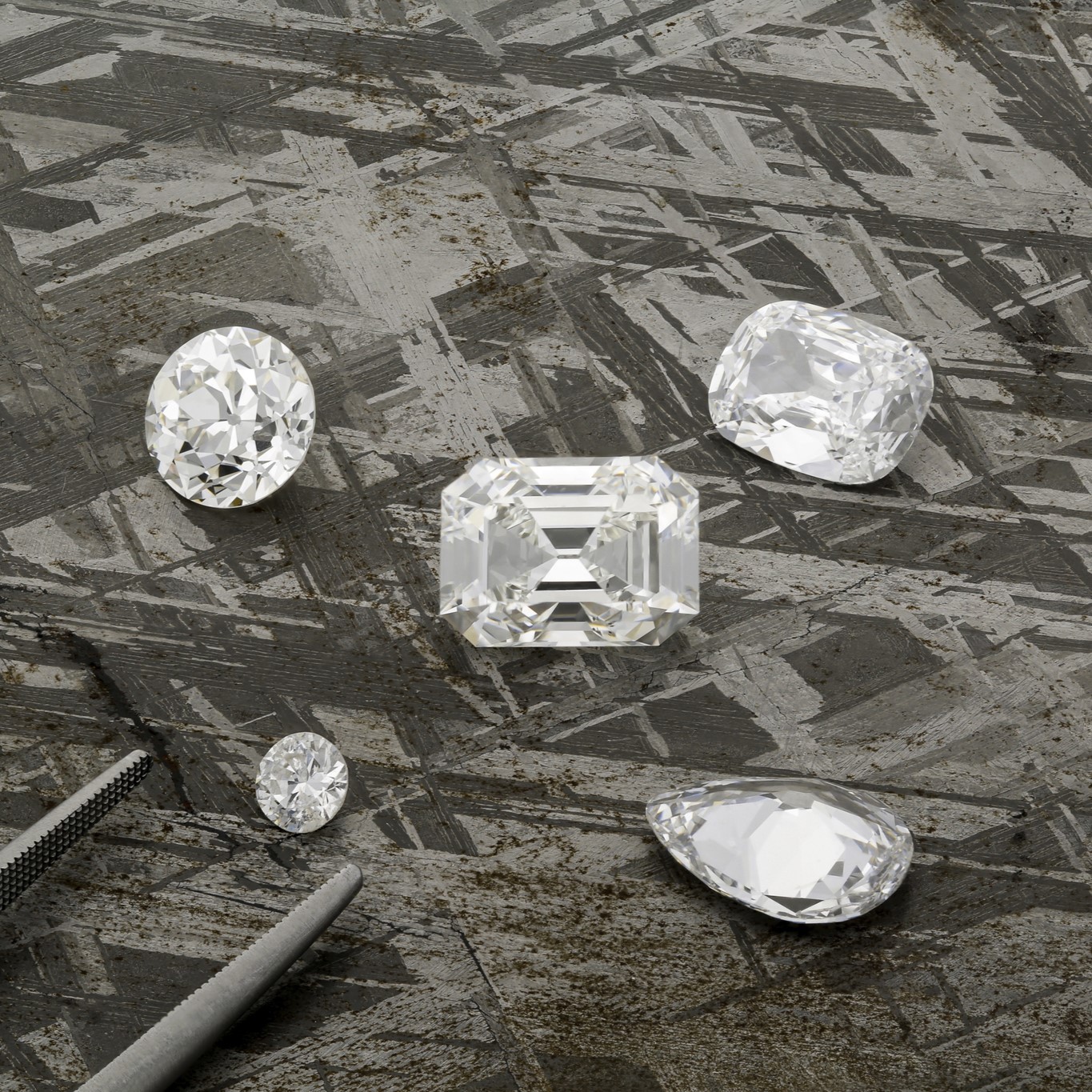
The design of the French cut had developed from the addition of extra facets to old table cut diamonds thereby altering them into much more lively stones. This style of cut has changed very little to this day and its evolution marks one of the earliest milestones in the development of the brilliant cut diamonds we know today.
Pigeon’s Blood Rubies

Historically, the term ‘pigeon’s blood’ has been used to describe the most beautiful and coveted colour for rubies, allegedly due to its similarity in colour to the blood of a pigeon.
Opinions differ as to the exact origin of the term with some saying it came from the Burmese, others that it was first used by the Chinese who had previously owned the area where the Burmese ruby mines were discovered and yet others sighting it as having Hindustani origins where lapidaries compared the colour to the blood red of a pigeon’s eye. Whatever the truth, one thing everyone agreed on is that only rubies of the finest vivid red colour with deep saturation and which showed a soft red fluorescence in daylight were referred to this way. Today rubies from both Burma and Mozambique can show this coveted colour and be certified as such.
Mozambique Rubies

The first significant ruby deposit in Mozambique was discovered in 2009 in an area called Montepuez. Remarkably, in less than fifteen years this country has become the world’s most productive source of gem-quality rubies.
Importantly, the output is not only significant in quantity but also in quality. The rubiesoccur in a wide range of qualities and characteristics but the best of them are low in iron and high inchromium like those from Burma and exhibit a similar vibrant colour with a strong fluorescence. The bestof the best of these will be given with the coveted ‘pigeon’s blood’ colour grade. A percentage of thesecombine this highly desirable colour with a level of clarity that means the stones require no treatment toimprove them. This means that excellent quality, untreated stones are available and these are the oneswe select for our jewellery.
Emeralds
Colombian Emerald

Historically, the very finest quality emeralds have been found in Colombia, in particular three key mining areas - Muzo, Coscuez and Chivor - which between them have been supplying the world with exceptional gems for many hundreds of years.
Stones from these locations are widely regarded to be the most beautiful and intense in colour with a purity of green unmatched by those from any other source. Whilst the earliest record of emerald mining was in Ancient Egypt, indeed Cleopatra loved these gems so much she is reputed to have had her own mine, the beauty of the stones from Colombia could not be rivalled. Since the 16th Century these stones have been widely traded throughout Europe and their superiority in terms of colour and size meant they quickly became the most highly prized emeralds in the world. Mining in these areas continues today and they are still producing exceptional quality gems which are as desirable today as they were to the early Colombians who first discovered them.
No Oil

Emeralds that have been certified as having no traces of oil in them are particularly rare. Almost all emeralds are treated with oil, usually at source, to enhance their clarity. This is such common practice that finding an emerald without any trace, however minor, is something special and truly noteworthy.
Zambian Emeralds

The first emeralds were found in Zambia as far back as the 1920s but they were not mined in any significant quantities until the 1970s. Today, Zambia is considered second only to Colombia as an important source of emeralds in terms of value.
The primary mining area is Kafubu and the most significant concessions are Kagem, Grizzly and
Chantete, all of which are open-pit mines. Currently Kagem alone is producing in the region of
20-25% of the worlds emerald supply. The output is varied in terms of both colour and clarity
but the top end of the range is acknowledged as very fine indeed. These emeralds get their
intensely saturated green colour from a combination of chromium, iron and beryllium. This iron
content is also significant in terms of durability as it helps to create a stronger internal
structure meaning that emeralds from this area measure slightly higher on the gemstone hardness
scale than those from other localities.
In 2018, the Kagem mine uncovered a significant 5,655-carat emerald. Named Inkalamu (meaning
lion) this gem was notable not only for its size but also for its exceptional clarity and evenly
saturated colour. Two years later in 2020, the same mine produced an even larger 6,225-carat
emerald which was subsequently named Insofu (meaning elephant). These extraordinary finds, like
all the emeralds in this area were formed more than 450 million years ago thanks to surging
magma from the earth’s mantle encountering a specific set of minerals in just the right
environment to allow for emerald crystal growth
Ural Mountain Emeralds

Emeralds were first discovered in the Ural Mountains in the early part of the 19th Century in an area about 100km northeast of Ekaterinburg. The story goes that in 1830 a local man noticed some green crystals around the roots of a fallen tree near the Takovaya river.
It didn’t take long to establish what they were and organised mining began within just a few
months. However, the world didn’t see any of the emeralds that were excavated over the coming
decades as they were regarded as property of the Russian crown. It wasn’t until the very end of
the century that this changed, when the Tsar took the decision to lease the mines to the New
Emerald Company (due to the ever-increasing costs of running them) and over the next 18 years
the company exported over 40 million carats of rough emerald. Quality varied with some crystals
suitable only for carving whilst others were perfect for faceting into beautiful gems with good
strong colour and high transparency and clarity.
In 1918 the Soviet government took ownership and control of the mines and production continued
apace with millions of carats mined each year, sometimes even exceeding the output of the
world-famous Colombian mines. During the 1940s and 50s the focus of mining in this area turned
towards beryllium ore, however emeralds were still recovered as a by product of this search and
production.
The focus shifted back again in the 1970s as demand for emeralds increased and new localities
for the ore were discovered elsewhere. Mining continues today and a walk around any major gem
fair will reveal a selection of Ural Mountain emeralds available for sale. However, these stones
are unquestionably rarer than those from larger more commercial localities such as Zambia and
Colombia.


Variations of this type of cut were used widely on coloured gems from around the 16th century onwards. The straight facets of an emerald cut are applied in a stepped pattern which means they have a different character to the brilliant cut styles of faceting thereby allowing the colour of the gem to be seen and enjoyed to the fullest without any distraction.
It was several centuries before this cut was used on diamonds but during the first half of the 20th century, emerald cut diamonds began to appear and grow in popularity. Their sleek geometric appearance suited the aesthetic of the Art Deco period and the elegant feel of the stones which offered a cleaner icier look than their brilliant-cut sisters were loved by women looking for something a little different. The emerald-cut diamond is however less forgiving than a brilliant cut one in terms of concealing inclusions and hints of colour. Because the style and shape of the facets does not create as much fire and brilliance to distract the viewer, the quality of these stones can be clearly seen and therefore needs to be as good as possible to ensure the most beautiful gem.
The earlier emerald cuts that we favour using in our jewellery are typically characterised by large wide-open tables which act as a window into the stone, large cut corners and higher tables and often flat open keels. These stones are supremely elegant and have a quiet understated look that is very appealing.
Director’s Notes
Rubies mined in Burma have long been held as the absolute ideal in terms of colour for a ruby, they are an exceptionally beautiful rich deep red with neither too much brown nor pink in it. The Mogok Valley in Upper Burma (now known as Myanmar) has been the world’s primary ruby source for centuries and the origins of the mines are swathed in mystery and legend. What is certain is that references to these gems have been found dating back to the Shan Dynasty in the 6th Century. The mines were taken over by the King of Burma in 1597 and all rubies over a certain size had to be given to him on discovery rather than sold. Today there are many different mines in the area both privately owned and government run. New deposits were found in the Mong Hsu area of the country in the 1990’s and more recently a new source has been discovered in the northern region of Namya. Historically, the very finest quality emeralds have been found in Colombia, in particular three key mining areas - Muzo, Coscuez and Chivor - which between them have been supplying the world with exceptional gems for many hundreds of years. Stones from these locations are widely regarded to be the most beautiful and intense in colour with a purity of green unmatched by those from any other source. Whilst the earliest record of emerald mining was in Ancient Egypt, indeed Cleopatra loved these gems so much she is reputed to have had her own mine, the beauty of the stones from Colombia could not be rivalled. Since the 16th Century these stones have been widely traded throughout Europe and their superiority in terms of colour and size meant they quickly became the most highly prized emeralds in the world. Mining in these areas continues today and they are still producing exceptional quality gems which are as desirable today as they were to the early Colombians who first discovered them.


